AI Search
How Visible Are UK Small Businesses in ChatGPT?
We tested 250 local business recommendations across five UK locations and five sectors to see how consistent ChatGPT's recommendations are and which signals appear most often.
By Andrew Walsh · 2026-10-30
We tested five types of local business: builders, plumbers, electricians, garden landscapers and accountants.
These were tested across five UK locations: Shrewsbury, Cheltenham, Birmingham, Bristol and Manchester. This created 25 location and service combinations.
For each combination, we used two prompts. The first asked: “What are the best [service] in [location]?” The second asked: “Recommend 5 reputable [service] in [location] for someone looking to hire a local company.”
Each prompt was run in a fresh Temporary + Unpersonalised ChatGPT conversation to reduce the potential influence of previous conversations, memories or account personalisation.
We recorded the first five businesses recommended for each query, giving us 50 separate ChatGPT searches and 250 top-five recommendations.
Where a recommendation could not be matched with complete confidence across both searches, we treated it as unconfirmed rather than assuming it was the same business. The overall repeat figure should therefore be considered a conservative measure of recommendation consistency.
This study measures the stability of ChatGPT’s recommendations when a query is rephrased. It is not intended to determine which businesses are objectively the best in each location.
How consistent are ChatGPT’s local business recommendations?
Across all 25 tests, 84 of the 125 businesses appearing in the first top-five results were confirmed as appearing again after the prompt was reworded.
That gives an overall confirmed recommendation repeat rate of 67.2%. In other words, roughly two-thirds of the businesses initially recommended remained in ChatGPT’s shortlist after a relatively small change in wording.
The exact order was much less consistent. Only 38 of the 125 positions, or 30.4%, were occupied by the same business in both searches.
This suggests businesses should be cautious about thinking of ChatGPT recommendations like a traditional search ranking. The more useful question may be whether a business consistently remains within the group ChatGPT considers relevant enough to recommend.
Which sectors had the most stable recommendations?
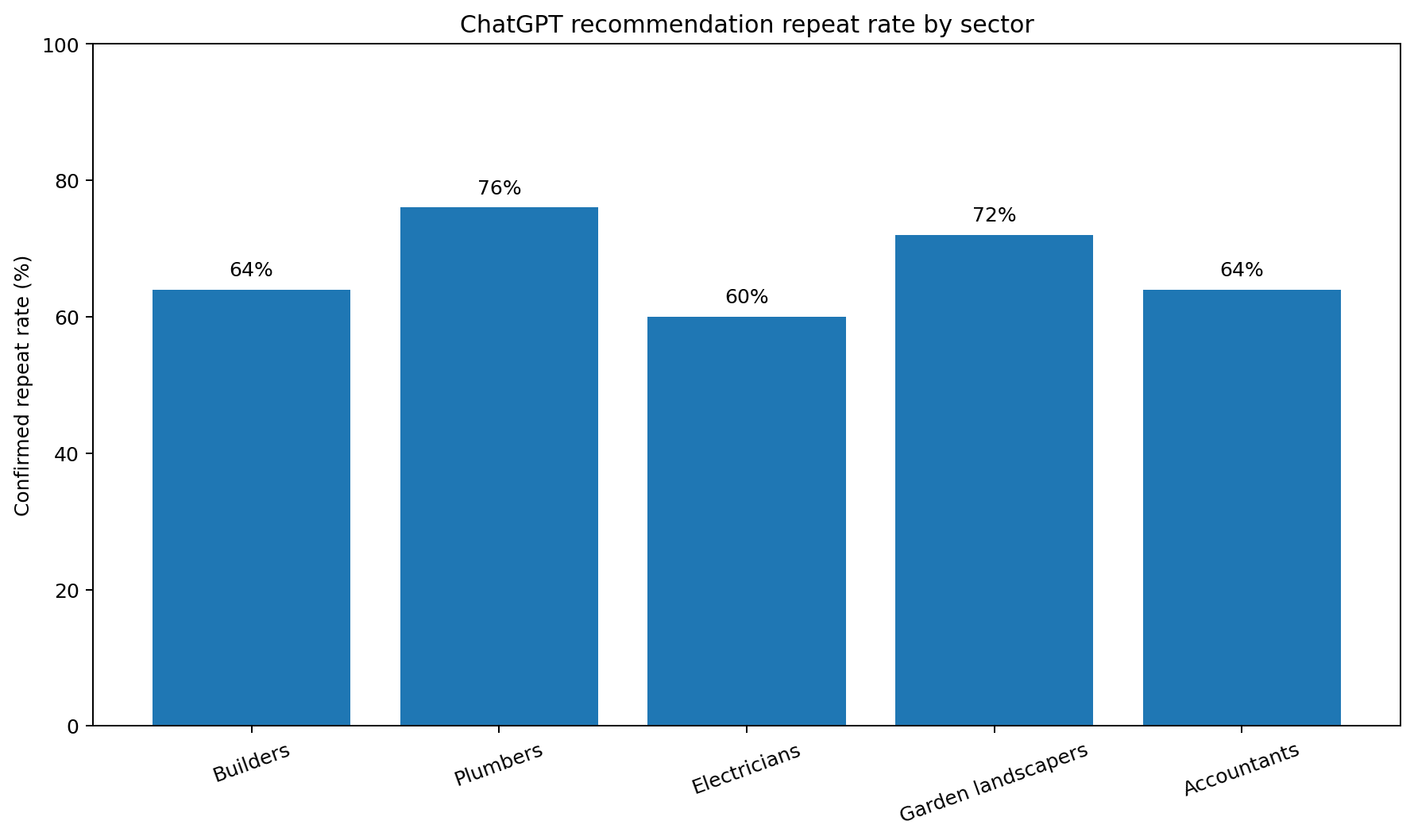
Recommendation stability varied noticeably between sectors. Plumbers produced the most consistent results, with 76% of the businesses in the first top-five shortlist appearing again after the prompt was reworded.
The confirmed repeat rates were:Plumbers – 76%Garden landscapers – 72%Builders – 64%Accountants – 64%Electricians – 60%
Plumbers were therefore the most stable category in our sample, while electricians were the least stable. Even so, 60% of the original electrician recommendations still repeated across the two prompt variations.
Garden landscapers had the highest exact-position stability. 44% of the businesses in that sector remained in exactly the same position across both searches, compared with 24% for builders and electricians.
Which locations had the most stable recommendations?
We also found some variation between the five locations tested.
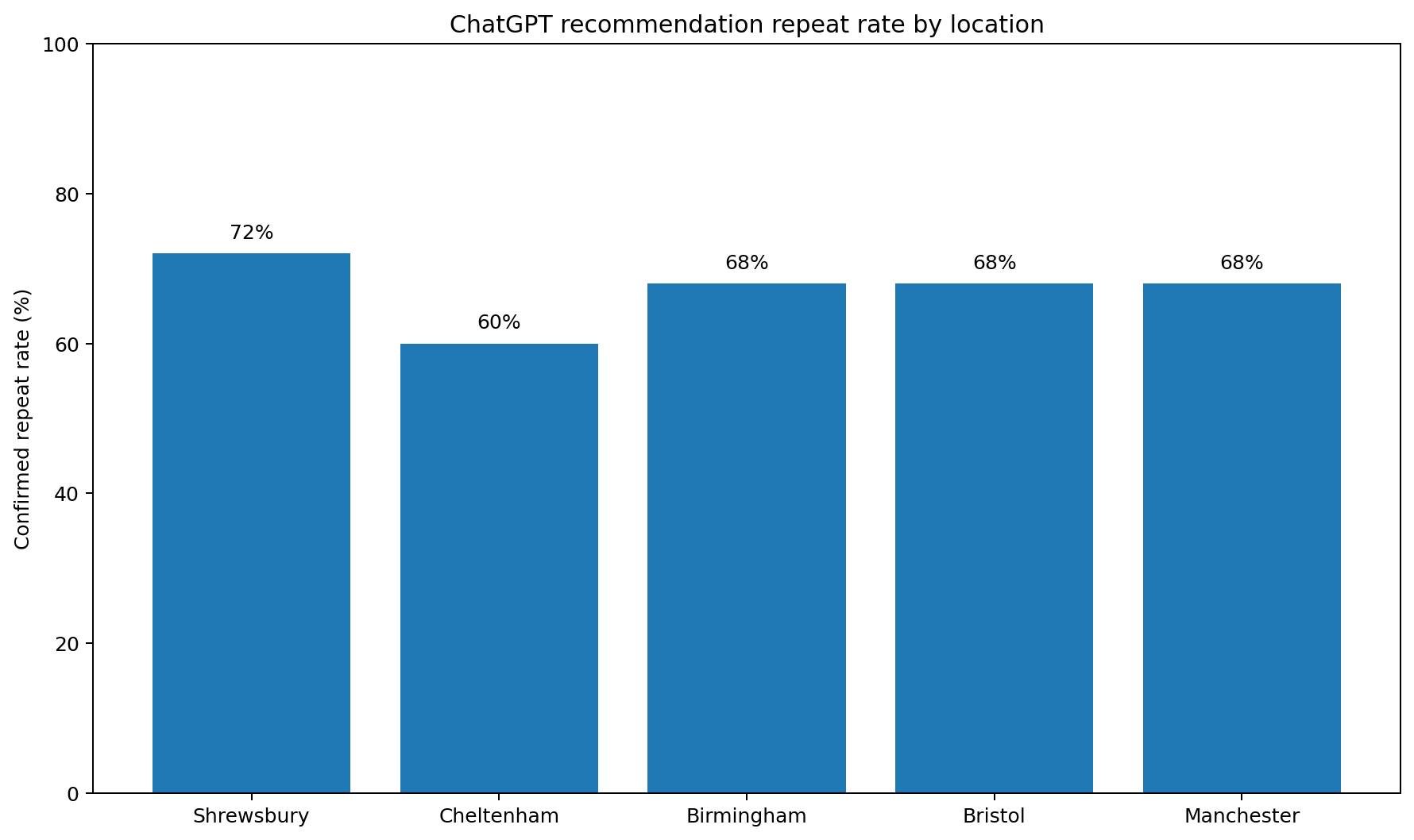
- Shrewsbury – 72%
- Birmingham – 68%
- Bristol – 68%
- Manchester – at least 68%
- Cheltenham – 60%
Shrewsbury produced the highest confirmed overlap, while Cheltenham produced the lowest.
The sample is not large enough to claim that ChatGPT is inherently more consistent in one city than another. It does, however, show that the amount of movement can differ substantially between local markets.
What signals appeared alongside businesses ChatGPT recommended?
During the tests, ChatGPT frequently referred to information beyond a business’s own website. These signals included customer reviews, professional registrations, trade bodies and established third-party directories.
Some of the names that appeared repeatedly included:
- Checkatrade
- Which? Trusted Traders
- Federation of Master Builders
- Gas Safe
- ICAEW
- ACCA
- NICEIC
- NAPIT
- TrustMark
- TrustATrader
The exact sources varied by sector. For builders, Federation of Master Builders membership and trade directories appeared regularly. For electricians, NICEIC, NAPIT and the Electrical Competent Person Register were mentioned frequently.
Gas Safe was particularly relevant to plumbing and heating businesses, while ICAEW and ACCA credentials appeared within accountant recommendations.
This does not prove that obtaining any one listing or accreditation will make a business appear in ChatGPT. What the study does show is that ChatGPT frequently uses these kinds of third-party signals when explaining why a business may be worth considering.
Do businesses that repeat have more reviews?
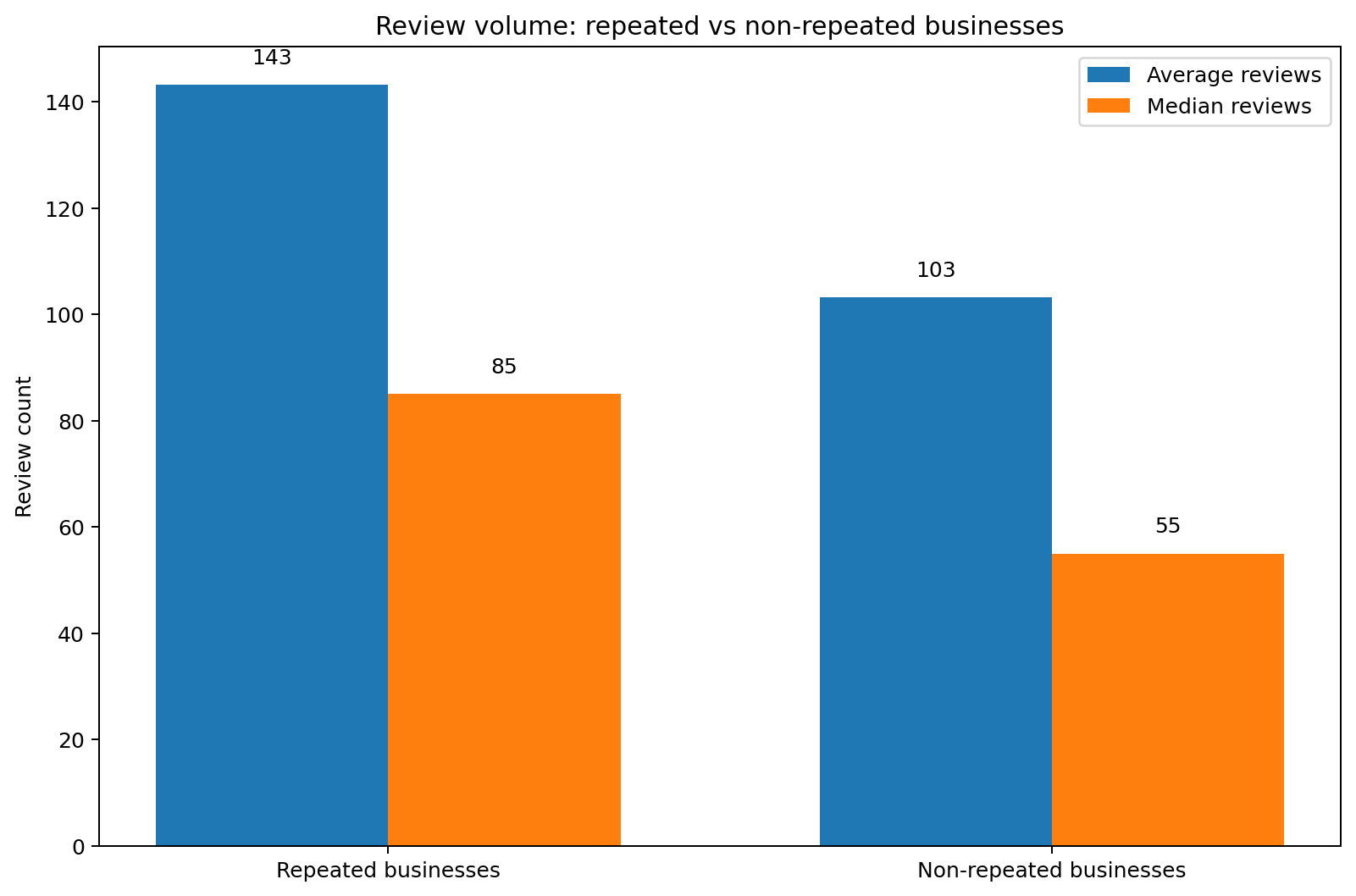
One of the more interesting differences in the study was review volume. Among businesses where a review count was visible, the businesses that appeared across both prompt variations tended to have more reviews than those that did not repeat.
The average review count was:
- Repeated businesses – 143 reviews
- Non-repeated businesses – 55 reviews
That suggests review volume may be worth paying attention to when considering AI visibility. However, this is an association within our sample rather than proof that having more reviews directly causes a business to appear more often in ChatGPT.
Average star rating showed almost no difference at all. Both repeated and non-repeated businesses averaged approximately 4.95 stars, which suggests the number of reviews may be more interesting than the difference between, for example, a 4.9 and a 5.0 rating.
What does this mean for small businesses trying to appear in ChatGPT?
The study suggests there is unlikely to be one isolated “ChatGPT ranking factor”. The businesses that appeared consistently tended to have several types of information available that made them easier to understand and verify.
For a small business, that means the fundamentals still matter. Your website should make it clear what services you provide, where you operate, what type of customers or projects you specialise in and how people can contact you.
Information about the business should also be consistent outside the website. Relevant directories, professional bodies, customer reviews and credible third-party mentions can all provide additional evidence that the business exists, operates in a particular location and provides the services being searched for.
This is also why AI Search Optimisation should not be treated as completely separate from SEO. A well-structured website, useful service content, accurate business information, customer reviews, relevant citations and genuine authority signals can support traditional search visibility while also making a business easier for AI systems to interpret.
Our results also show why businesses should be cautious about trying to “rank number one in ChatGPT”. The exact ordering changed frequently. Across the study, more than two-thirds of the original businesses remained in the recommendation set, but fewer than one-third retained exactly the same position.
A more practical objective is therefore to build enough clear, credible and consistent information around the business that it continues to be considered when relevant recommendation queries are asked.
About the data
This study was carried out by Digivark Local in October 2026. It covered five UK locations and five local business sectors, using 50 separate Temporary + Unpersonalised ChatGPT searches.
The results describe what appeared during those searches at that point in time. ChatGPT recommendations can change as online information changes and as the underlying product and search systems develop.
Review counts, ratings and third-party signals were recorded from information surfaced during the recommendation tests rather than through a complete manual audit of every business.
The findings therefore show patterns within this dataset rather than proving that any individual factor directly causes a business to be recommended by ChatGPT.
If you want to understand how your own business could improve its visibility in AI-powered search, take a look at our AI Search Optimisation service.